The Drau Cycle Path - Stage 1 from Innichen to Lienz
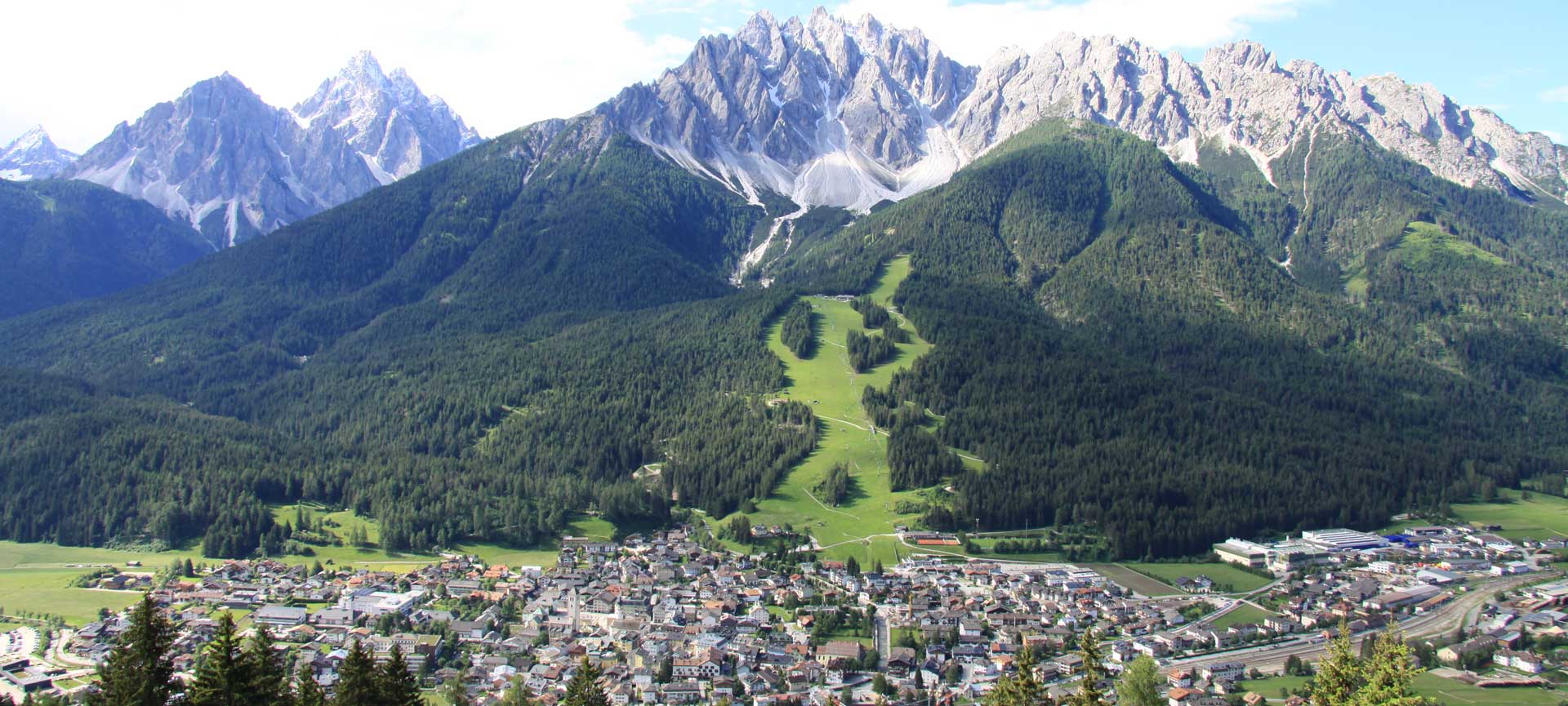
A radiant blue sky, the gentle murmur of a young mountain stream in your ear, and the striking, rugged peaks of the Sesto Dolomites as constant companions in your peripheral vision – welcome to the Hochpustertal! If there's one cycling route that perfectly combines scenic beauty, cultural diversity, and absolute cycling fun for the whole family, it's the legendary Drau Cycle Path.
For all those who want to leave the stressful daily routine behind and instead feel the refreshing wind in their face, this river cycle path is an absolute must-do. And the best part? The adventure begins right on our doorstep. Those who check into the Glinzhof in Innichen not only perch at an altitude of 1,500 meters above the valley basin with a majestic box seat view of the Haunold and the Dolomites, but also have the perfect starting point for an unforgettable cycling adventure right at their feet.
This first, alpine section is often listed in tour planners as part of the Pustertal Cycle Path before it finally heads downstream. In this detailed guide, we'll take you on a journey along the entire Drau Cycle Path, look at the overall route planning, and then focus precisely on the undisputed highlight for leisure cyclists: Stage 1 from Toblach or Innichen to Lienz in East Tyrol. Pack your sunscreen, check your tire pressure, and come along on a tour that proves that sometimes the journey truly is the most beautiful destination!
Table of Contents
- The Drau Cycle Path at a Glance: Limitless Cycling Pleasure
- The 7 Drau Cycle Path Stages: Why the Drau Cycle Path Map is Your Best Friend
- Where it All Begins: The Source of the Drau in Toblach and Historic Innichen
- Pure Inspiration: The Drau Cycle Path in Video
- Drau Cycle Path Stage 1 in Focus: From Toblach/Innichen to Lienz
- The Detailed Route: From South Tyrol Across the Border to East Tyrol
- Culinary and Cultural Highlights Along the Route
- The Most Beautiful Nature Highlights Along Drau Cycle Path Stage 1
- The Convenient Return Journey: Back to Innichen with the Pustertal Railway
- The Glinzhof: Your 5-Flower Wellness Oasis at 1,500 Meters
- Practical Checklist for Your Drau Cycle Path Tour
- The Drau Cycle Path: An Unforgettable Experience in the Heart of the Alps
The Drau Cycle Path at a Glance: Limitless Cycling Pleasure
Before we swing into the saddle and examine the first stage, it's worth looking at the bigger picture. Anyone who studies the complete Drau Cycle Path Map quickly realizes: This cycle path (also known as R1) is not just a local cycle path – it is a lifeline for sustainable tourism in the Alpine-Adriatic region and has been rightly awarded a 5-star quality cycle route by the German Cyclists' Federation (ADFC).
The Drau Cycle Path: 510 Kilometers Through Four Countries
With a total length of around 510 kilometers, the cycle path follows the course of the Drau from its modest origin in South Tyrol's Puster Valley to its mouth or its further course far to the east.
What makes it special is its absolutely unifying, cross-border character. Anyone who conquers all Drau Cycle Path stages crosses no less than four countries:
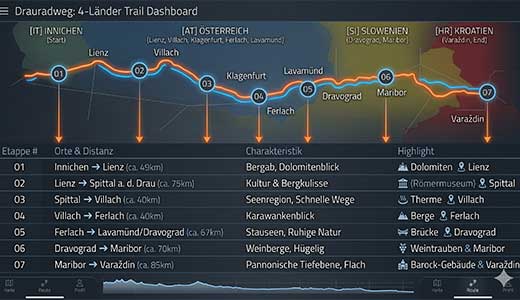
- Italy (South Tyrol): The alpine, crisp and fresh start in the face of the Three Peaks region on the Pustertal cycle path.
- Austria (East Tyrol and Carinthia): The longest and best-developed section, passing idyllic bathing lakes, rugged gorges, and historic towns such as Lienz, Spittal, and Villach.
- Slovenia: Here, the Drava reveals its wild, forested, and often still untouched side, as you cycle through charming places like Maribor.
- Croatia: The finale near Varaždin, where the river finally becomes calmer and the landscape transitions into the vast Pannonian Plain.
Cycling along the Drava: Alpine Scenery and Mediterranean Flair
The entire route is a prime example of successful infrastructure. The path is mostly asphalted, excellently signposted, almost continuously separated from motorized traffic, and has a pleasant gradient – at least for the first three hundred kilometers.
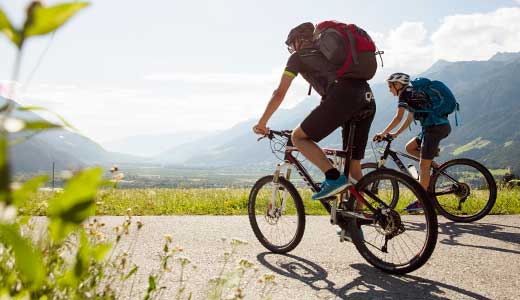
It is this combination of alpine scenery and Mediterranean flair, which shifts further and further south during the journey, that makes cycling here so unique.
The 7 Drava Cycle Path Stages: Why the Drava Cycle Path Map is Your Best Friend
If you take a look at the official Drava Cycle Path Map, you immediately recognize how masterfully this approximately 510-kilometer-long lifeline is laid out.
Tip for orientation: Feel free to zoom in on the map a bit to see how the route develops from our starting point in the Hochpustertal.
The entire route is traditionally divided into 7 classic Drava Cycle Path Stages, which gradually lead you from the high alpine mountain worlds of South Tyrol far to the south and east:
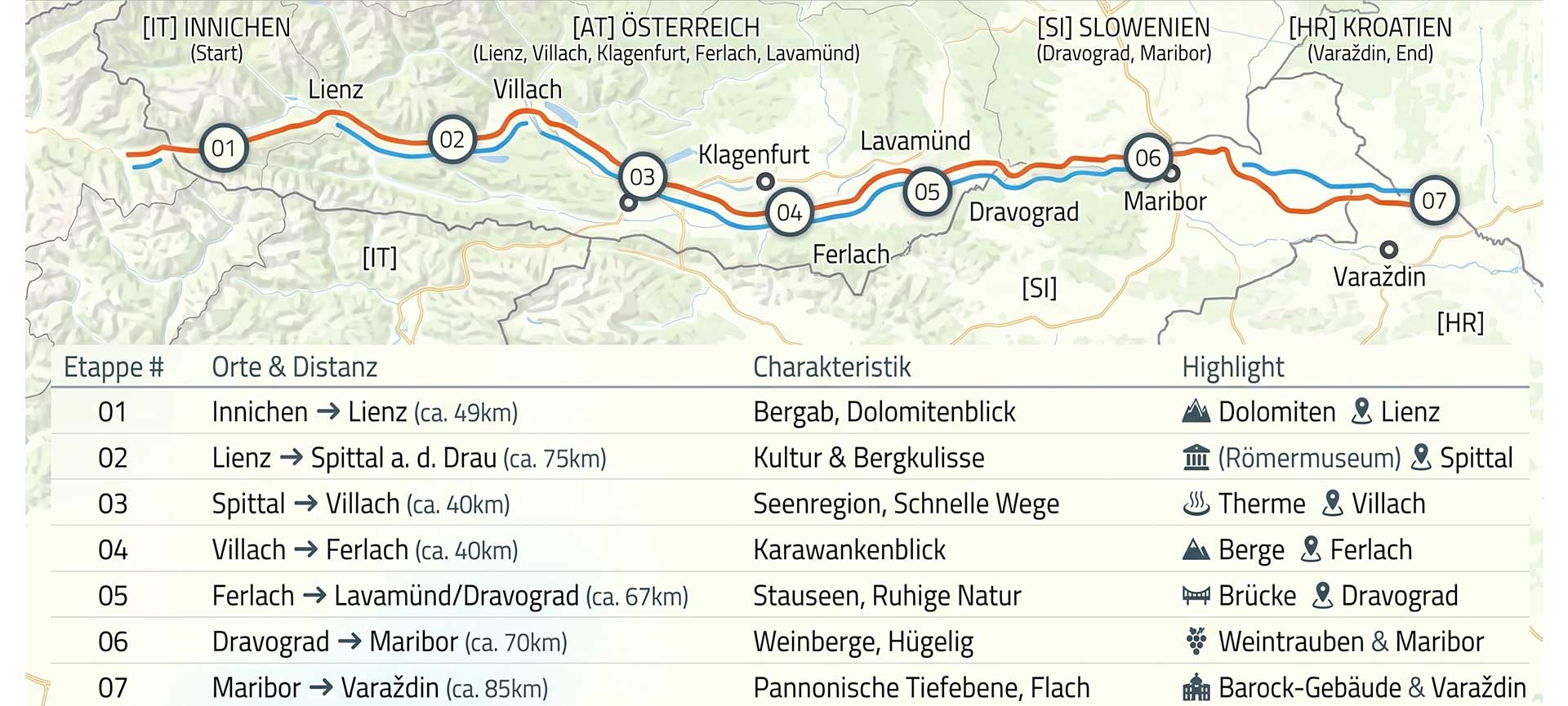
Drava Cycle Path Stages 1-7 - from Innichen to Varaždin
- Stage 1: Toblach/Innichen (Italy) – Lienz (Austria) | approx. 48 km The alpine pleasure highlight to start, which leads almost exclusively downhill.
- Stage 2: Lienz – Oberdrauburg | approx. 36 km A leisurely section through the wide Carinthian Gate.
- Stage 3: Oberdrauburg – Spittal an der Drau | approx. 50 km Passing idyllic villages and historic cultural landscapes.
- Stage 4: Spittal an der Drau – Villach | approx. 55 km Here the valley opens up and the path leads directly into the lively Drava city of Villach.
- Stage 5: Villach – Ferlach | approx. 50 km Passing the glittering Carinthian bathing lakes (such as Lake Faak) into the Rosental valley.
- Stage 6: Ferlach – Lavamünd | approx. 65 km Along impressive reservoirs almost to the Slovenian border.
- Stage 7: Lavamünd – Maribor/Varaždin (Slovenia/Croatia) | approx. 85 km The grand, cross-border finale, which leads through untouched natural areas into the Pannonian Plain.
Breakfast for Champions: Power from Nature's Own
Anyone who studies the Drauradweg Map a little more closely will immediately notice an invaluable logistical advantage: The route is perfectly coupled with the regional train network. No matter where you are on the first sections – the tracks are rarely far away. This gives cyclists enormous security. Should the weather change or you run out of breath, you simply roll to the next train station.
Another look at the elevation profile of the map also reveals the special feature of our location: While the later Drauradweg stages in Carinthia and Slovenia certainly feature some gentle hills, counter-climbs, and significantly longer distances, the very first stage is characterized by an almost continuous, relaxed descent.
For guests of the Glinzhof, a look at the map means one thing above all: You start at the highest point of the entire 510 kilometers! A cycling holiday can hardly begin faster, more relaxed, or more uncomplicated.
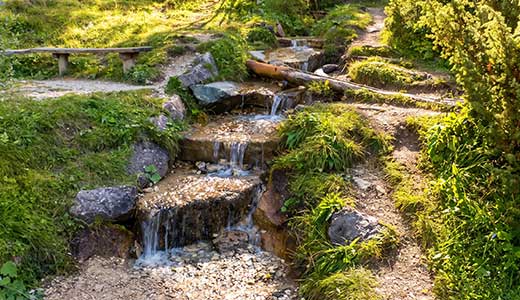
Where it all begins: The Source of the Drau in Toblach and historic Innichen
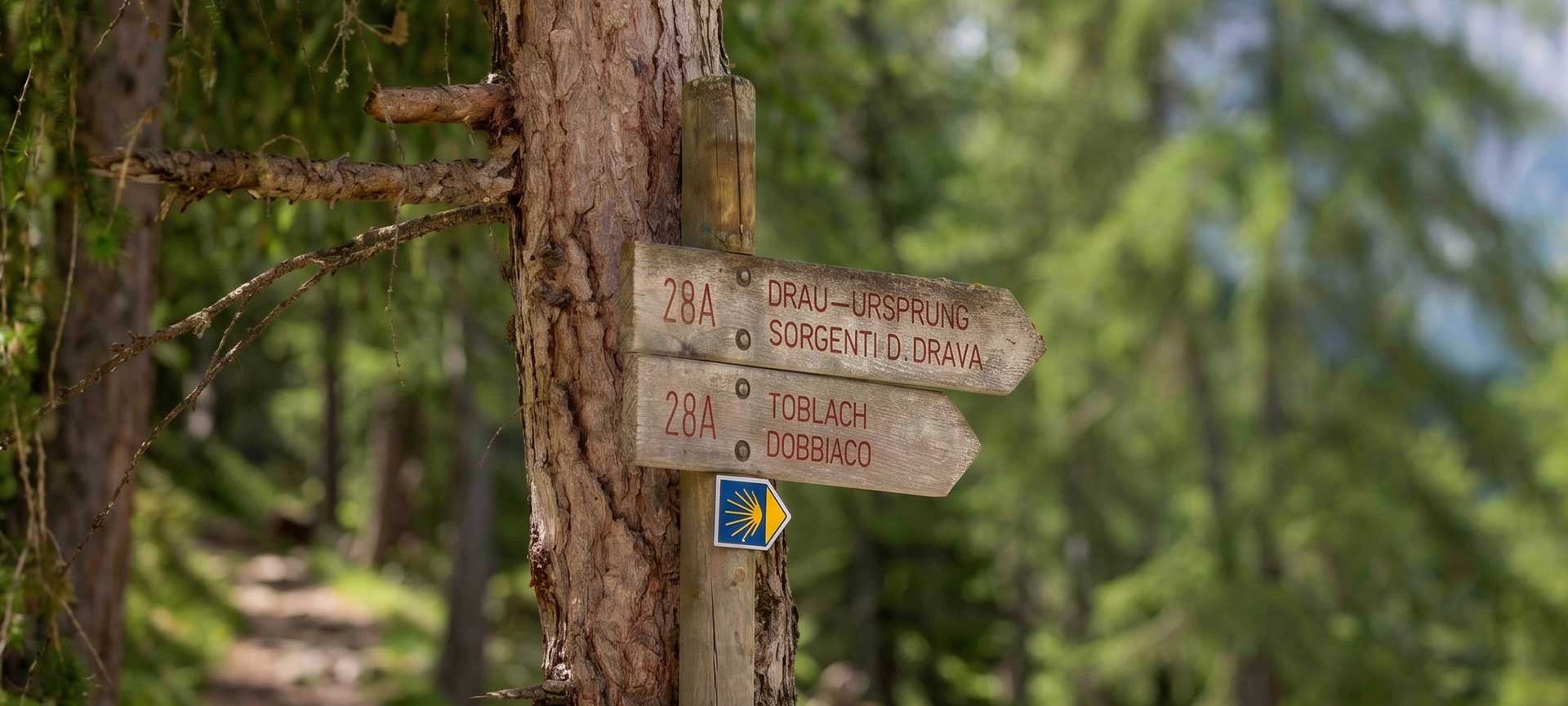
Every great river once started small. The Drau, which later develops into a mighty stream, originates in the so-called Toblach Field, a gentle watershed between Toblach and Innichen. Standing at the Drau source, it's hard to believe that this small, gurgling trickle from the springs of the Neunerkofel is the beginning of a river over 700 kilometers long.
Right here, at just under 1,210 meters above sea level, cyclists' hearts beat faster. Because from here, for the next almost 50 kilometers, a wonderful law of physics applies: It's almost exclusively downhill!
The Drau Source - from a small trickle to a great river
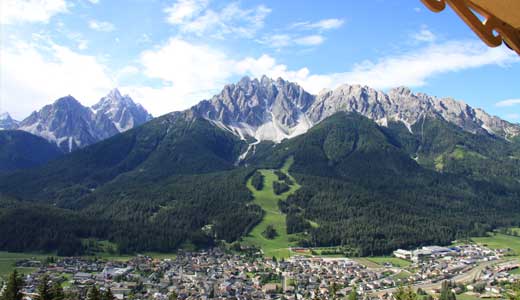
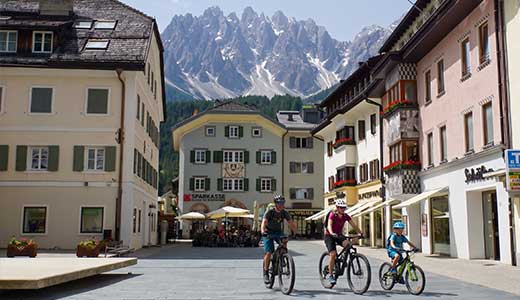
Just a few minutes from the source lies Innichen (San Candido). The charming market town exudes a very special flair with its colorful facades, historic churches (like the famous Romanesque collegiate church), and cozy pedestrian zones.
Here, South Tyrolean down-to-earthness meets a subtle Italian Dolce Vita. Before getting on the bike, it's worth taking a short stroll through the town center to drink an espresso or stock up on provisions at one of the local bakeries.
R1 - The Drau Cycle Path Stage 1: The Pustertal Cycle Path
Those who plan wisely sleep a little above the hustle and bustle on the beautiful Innichberg: The Glinzhof of the Jud family offers the perfect alpine oasis for this.
After a quiet night in a fragrant, sustainably designed old wood room and a hearty organic farm breakfast, you roll down to Innichen in the morning, completely relaxed, and directly join the Pustertal Cycle Path, which seamlessly transitions into the Drau Cycle Path here.
Pure Inspiration: The Drau Cycle Path in Video
Before we look at the details of the first stage, lean back for a moment and enjoy the official impressions. See how gently the paths glide along and what scenery awaits you – it immediately makes you want to get on the saddle yourself:
Drau Cycle Path Stage 1 in Focus: From Toblach/Innichen to Lienz
Now let's get to the heart of our article: the first of the many Drau Cycle Path stages. It is widely regarded as one of the most popular cycle paths in the entire Alpine region. Why? Because it is the perfect "family stage" and is hard to beat scenically.
The Route Profile at a Glance
| Feature | Details |
| Official Starting Point | Toblach / Innichen (South Tyrol, Italy) |
| End Point | Lienz (East Tyrol, Austria) |
| Route Length | approx. 49 kilometers |
| Elevation Gain Uphill | approx. 130 m |
| Elevation Loss Downhill | approx. 670 m |
| Difficulty Level | Easy / Perfect for Leisure Cyclists & Families |
| Path Condition | Continuously asphalted, excellently signposted |
The Pustertal Cycle Path: For Families, Seniors, and Leisure Cyclists
Since the gradient leads from almost 1,200 meters down to around 670 meters, you hardly have to pedal at all on some sections of this route. The bike practically "rolls" towards the destination all by itself.
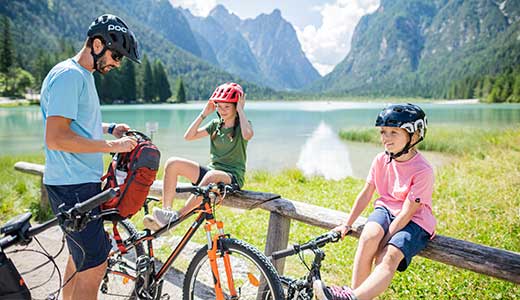
This makes stage 1 ideal for families with smaller children, leisure cyclists, seniors, or simply for anyone who wants to enjoy the panorama of the Dolomites without breaking a sweat.
The Detailed Route: From South Tyrol Across the Border to East Tyrol
To ensure your holiday starts as relaxed as it continues with us up on the mountain, we have come up with something special.
Since the Glinzhof is exclusively and quietly located on the Innichberg, no public bus drives directly to our door – and that's exactly what guarantees you the undisturbed idyll you are looking for.
We promise you one thing already: Even if you arrive by public transport - you certainly won't miss your own car up here. We ensure that you reach your destination flexibly, relaxed, and environmentally friendly at all times.
1. The Start in Innichen and the Ride to the State Border
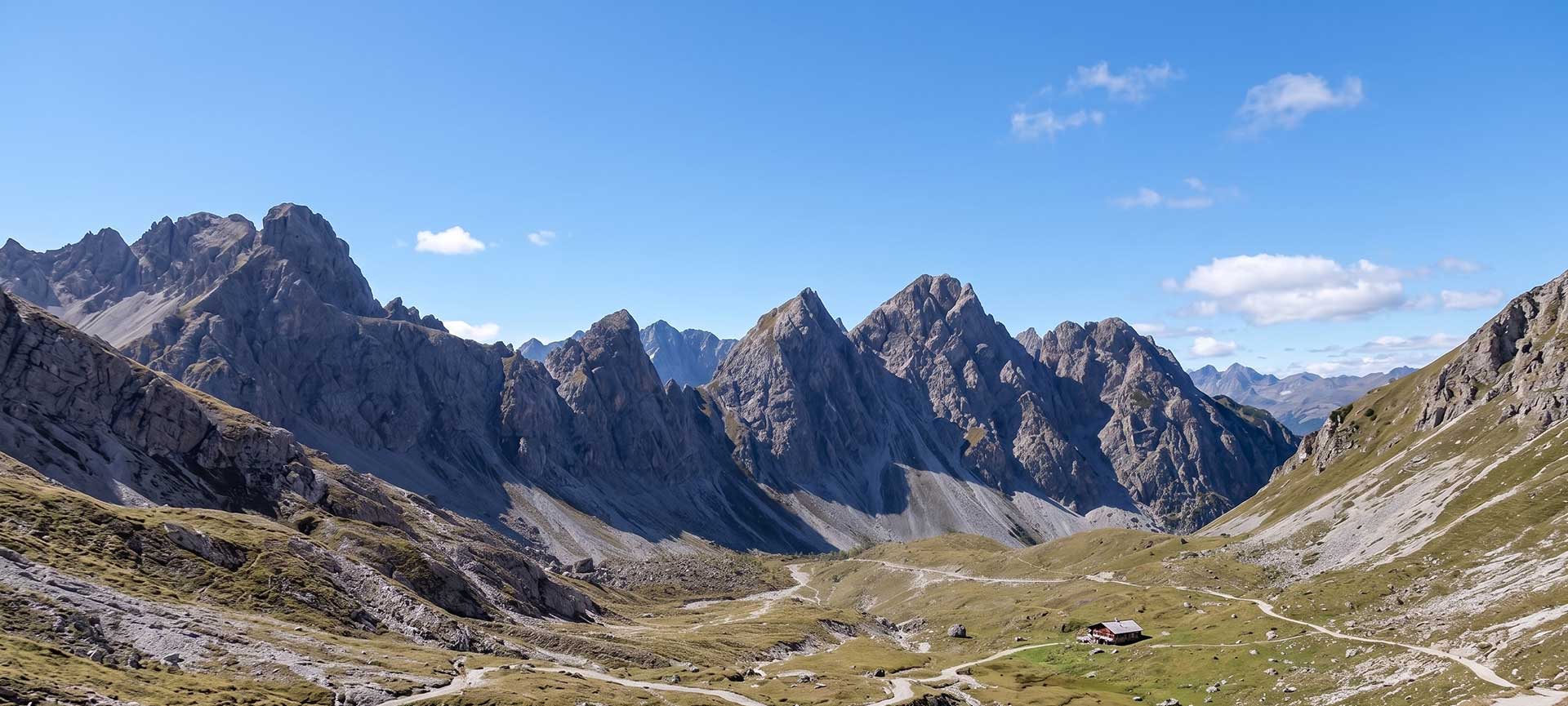
We start our tour in the town center of Innichen (or roll comfortably down into the valley from the Glinzhof). The cycle path is unmistakably marked with green signs. Right at the beginning, the Pustertal Cycle Path leads us past lush meadows, while to the right, the mighty rock faces of the Sesto Dolomites rise into the sky.
Here, the Drau is still a young, wild stream, accompanying us with its cheerful gurgling. The path is flat and pleasantly wide, leading via Vierschach towards the Italian-Austrian border. Today, the border itself is passed completely unnoticed – no customs, no controls, just an inconspicuous sign indicates that we are now in the Austrian federal state of Tyrol (more precisely, in East Tyrol). A beautiful symbol for a boundless Europe!
3. The Shady Middle Section: Through Gorges and Forests
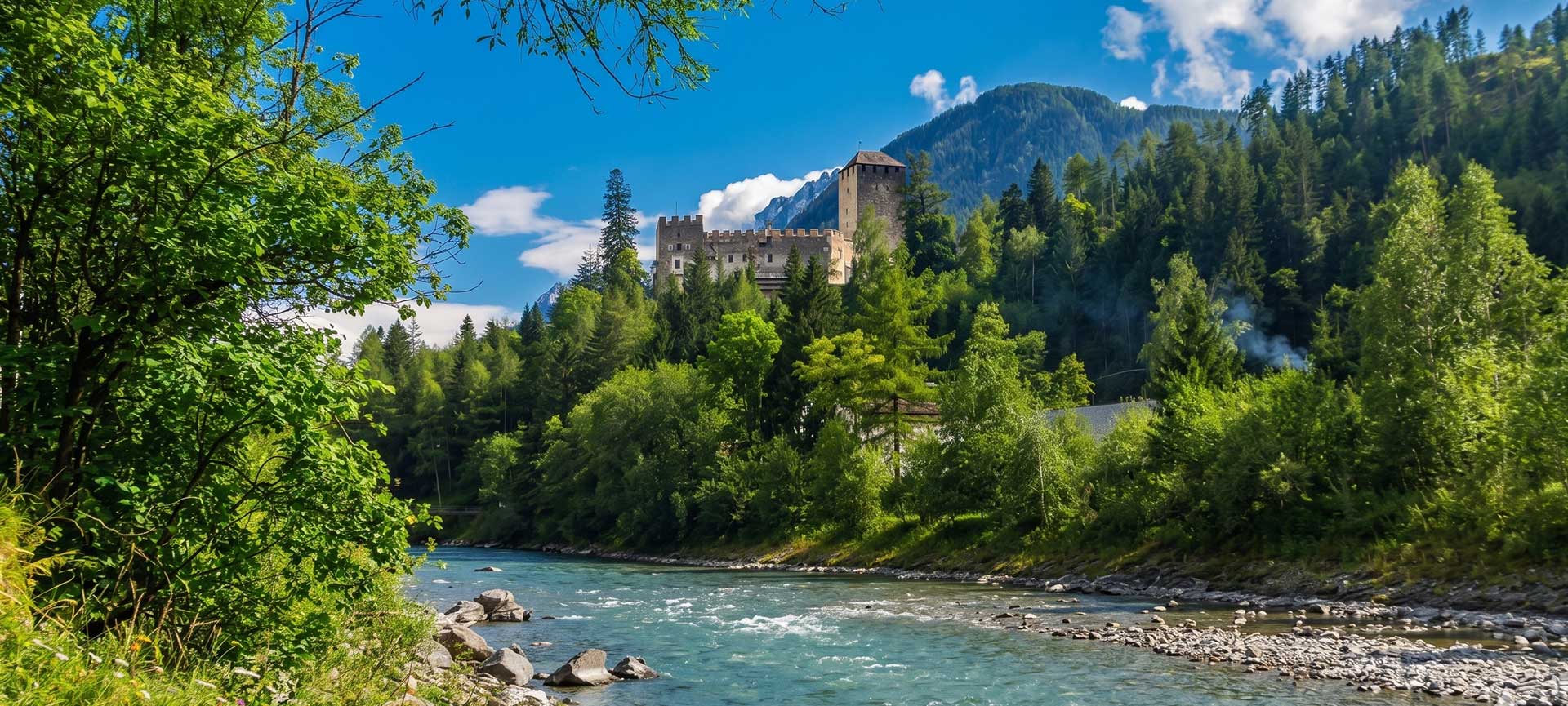
Behind Sillian, the cycle path hugs the course of the Drau river closely. This section is particularly refreshing in midsummer, as the path often leads through cool forests and shady passages. Towns like Strassen, Abfaltersbach, and Mittewald an der Drau are along our route.
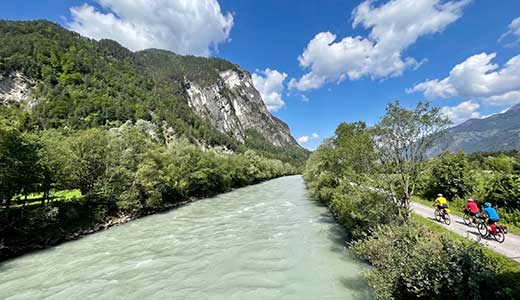
Although you are in the middle of the alpine region, the cycle path consistently runs away from the busy Pustertal federal road. You mostly hear only the rushing of the river and the whirring of your own tires. Again and again, lovingly designed rest areas and small wooden benches directly on the riverbank invite you to a short drink break.
2. Through the Upper Puster Valley: Sillian and Heinfels Castle
Shortly after the border, we reach Sillian, the main town of the East Tyrolean Puster Valley. Here, the landscape changes slightly: the valley becomes a little narrower, and the wooded slopes of the Villgraten Mountains in the north and the Carnic Alps in the south draw closer together.
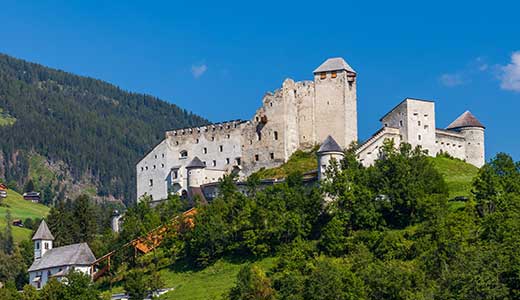
Visible from afar, the majestic Heinfels Castle, also known as the "Queen of the Puster Valley," sits enthroned on a prominent rocky hill. A quick glance upwards is always worthwhile, as the castle complex has been extensively restored in recent years and makes for a fantastic photo opportunity.
4. The Finale: Entry into the Lienz Valley Basin
After passing the narrow section near Mittewald, the valley suddenly opens up again. The view widens, and before us, the imposing, bright limestone walls of the Lienz Dolomites appear. The air becomes noticeably milder, almost Mediterranean.
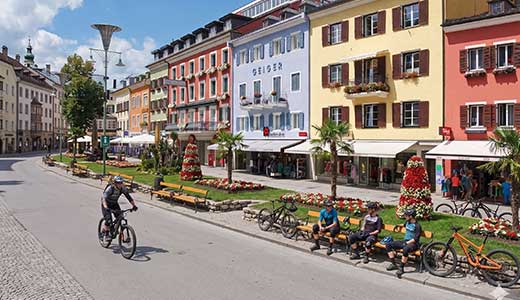
We pass through the villages of Thal and Leisach and finally roll along flat, wide paths into the East Tyrolean district capital, Lienz. Goal achieved! The city welcomes us with palm trees in the main square, colorful rows of houses, and a lively coffee culture that immediately invites relaxation.
Culinary and Cultural Highlights Along the Route
Anyone who uses the Drau Cycle Path or the Puster Valley Cycle Path solely for athletic activity misses out on the best parts. The route from Innichen to Lienz is packed with culinary temptations and exciting stopovers.
Here are the absolute highlights for which you should definitely plan some time, according to your Drau Cycle Path Map:
- The Loacker Enjoyment World in Heinfels: Located directly on the cycle path near Sillian, this stop is an absolute paradise for those with a sweet tooth. From afar, you can smell freshly baked waffles. Inside, an interactive exhibition teaches you everything about the famous waffle specialties, and you can shop to your heart's content in the café or the huge store. A perfect stop for families!
- The Vitalpinum in Thal: Anyone interested in the power of nature should take a break here. The Vitalpinum is a wellness park of the Brüder Unterweger pine oil distillery. In addition to a beautiful medicinal herb garden, there is a barefoot path, playgrounds for children, and a show distillery where essential oils are extracted.
- Bruck Castle in Lienz: Shortly before the official end of the first stage, Bruck Castle towers over the city. The former residence of the Counts of Görz now houses the Lienz City Museum and displays, among other things, an impressive collection by the famous painter Albin Egger-Lienz.
- Lienz Main Square: After the tour, there's nothing better than parking your bike, sitting down in one of the many cafés, and enjoying an ice cream or an original Tyrolean apple strudel. The southern flair of the city is the perfect contrast to the alpine start in South Tyrol.
The Most Beautiful Nature Highlights Along Drau Cycle Path Stage 1
The Drau Cycle Path not only shines with perfect asphalt paths but also leads you through some of the region's most fascinating natural landscapes. Pack your towel – at these spots, you'll experience nature up close:
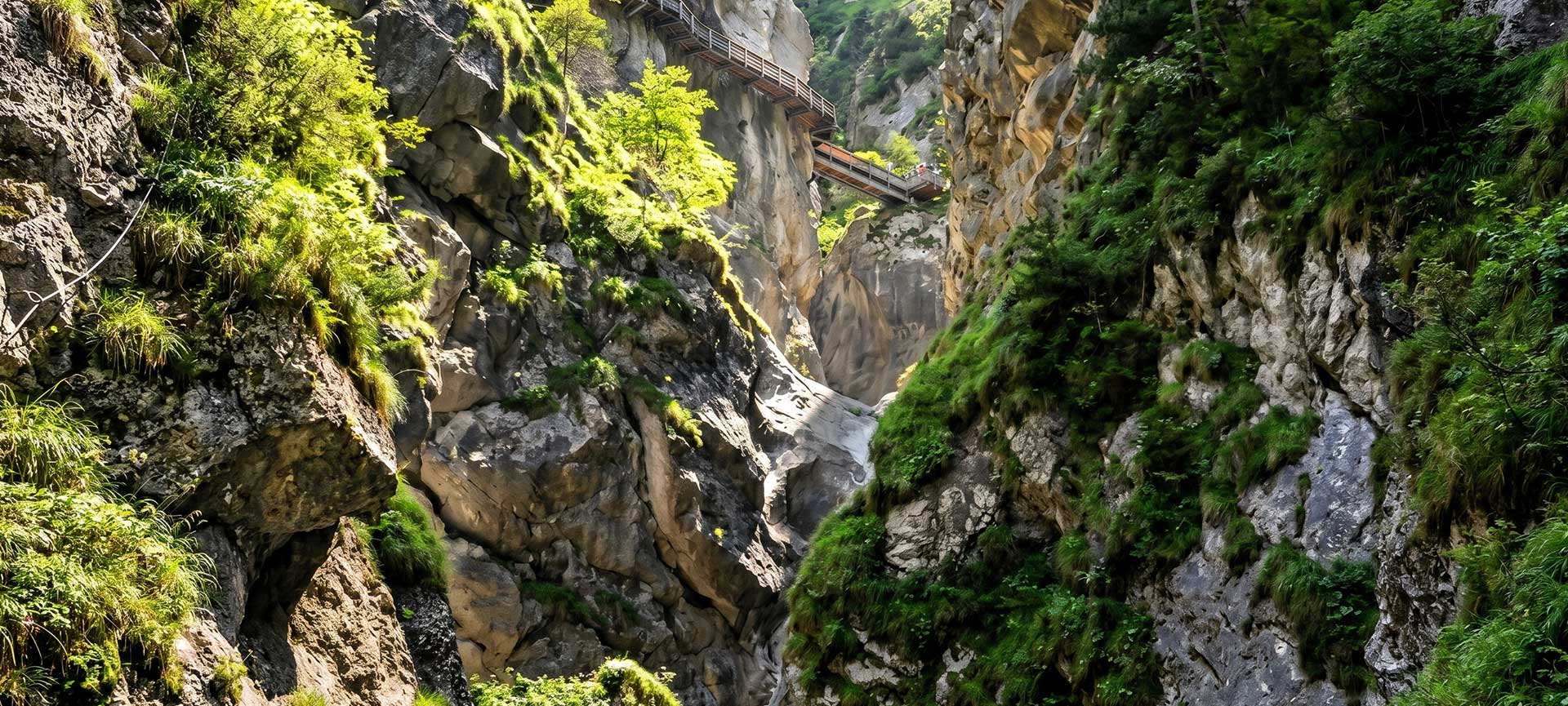
- The Spectacle of the Galitzenklamm (Leisach): Just before reaching Lienz, the tour's absolute scenic crown jewel awaits. The Galitzenklamm is a spectacular water trail where the Galitzenbach plunges with a deafening roar over steep rock faces into the depths. Solid wooden walkways allow you to hike directly past the spraying water masses. For families, there's a great water playground and a forest high ropes course, while the brave can venture onto the via ferratas in the rock face. A brilliant stop to feel the spray on your face!
- The Historic Aigner Badl (Abfaltersbach): A true, hidden gem in the middle of the forest near Abfaltersbach. The Aigner Badl is the last preserved farmer's bath in Tyrol and has been a protected monument since the 18th century. A healing, mineral-rich spring originates here. If you like, you can stop here and refresh your tired cyclist's calves in the cool water – pure natural healing, entirely in the style of old traditions.
- The Wild Gamsbach Estuary (Assling): At the height of Assling, the riverbed of the Drau widens, and the Gamsbach flows into a wide, natural gravel bank. This place has something wonderfully wild and untouched about it. It's the perfect spot to briefly park your e-bike by the roadside, walk barefoot over the round pebbles, and cool your feet in the ice-cold mountain water.
- The Frauenbach Waterfall (Lavant) – The Bonus Highlight on Stage 2: If you still have some energy left in your legs after arriving in Lienz, you'll be rewarded with a true natural gem here. Strictly speaking, this spot already belongs to the start of the second stage of the Drau Cycle Path, but it's only a stone's throw east of Lienz. The waterfall plunges impressively over the rock edges of the Lienz Dolomites into the depths. A shady, invigorating place that lies away from the crowds and radiates pure tranquility.
The Convenient Return Journey: Back to Innichen with the Pustertal Railway
A huge advantage of the first stage of the Drau Cycle Path is the perfect logistics. No one has to cycle back uphill for 50 kilometers and over 600 meters of elevation (unless you're looking for an extreme sporting challenge).
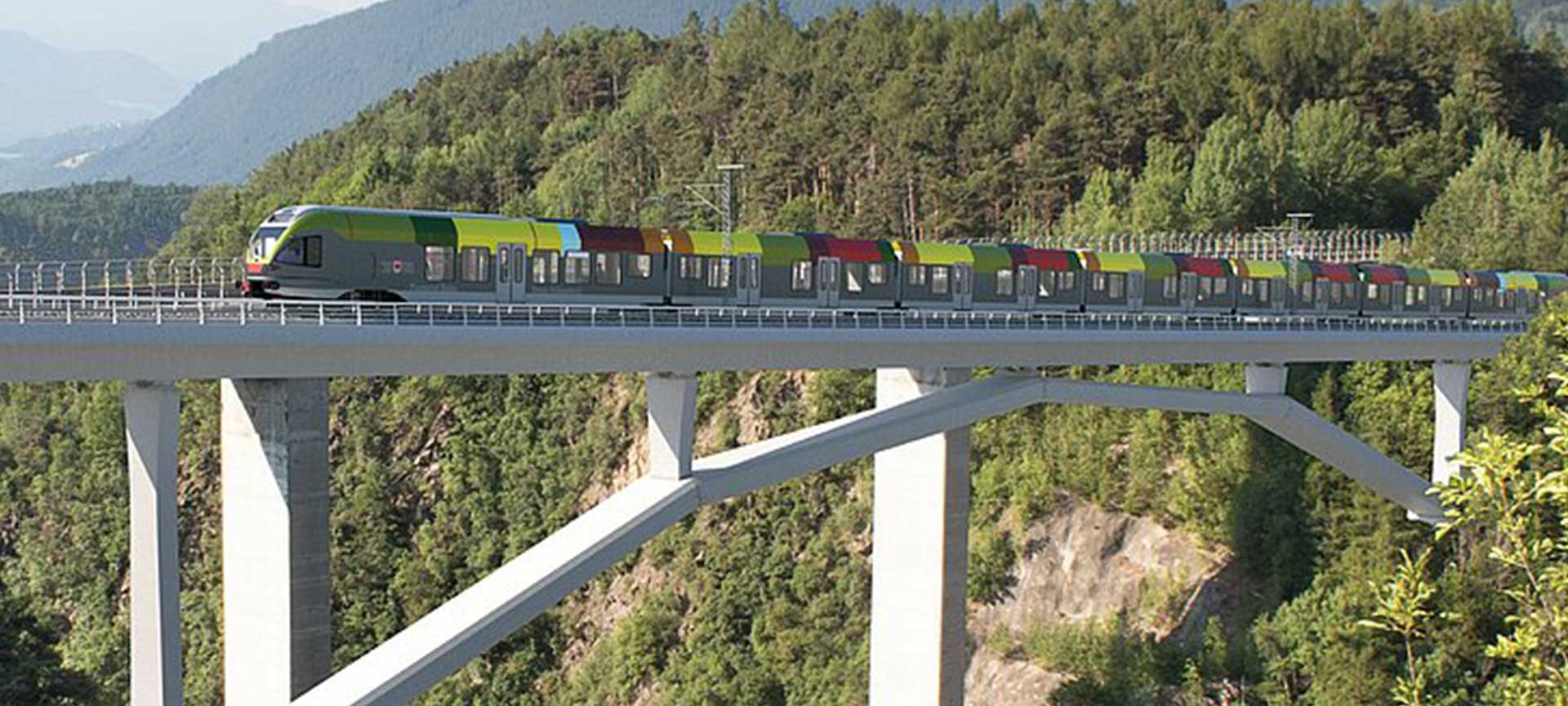
The Pustertal Railway (a modern regional train) runs regularly and at short intervals between Lienz, Innichen, and Toblach. The trains are specially designed for bicycle transport and feature spacious low-floor carriages where you can easily push your bikes in.
Tip for our guests: With the Südtirol Guest Pass, which you receive during your stay at Glinzhof, you enjoy many benefits on regional public transport. It's best to inquire in advance at Lienz train station about current combination tickets for bicycle transport across the national border – this way, your return journey will be absolutely stress-free and relaxed.
The Glinzhof: Your 5-Flower Wellness Oasis at 1,500 Meters
After a long day in the saddle, many new impressions, and a relaxing train ride, there's nothing better than returning to a place that feels like a true home away from home. The Glinzhof Mountain Natur Resort Agriturismo is exactly this magical place.
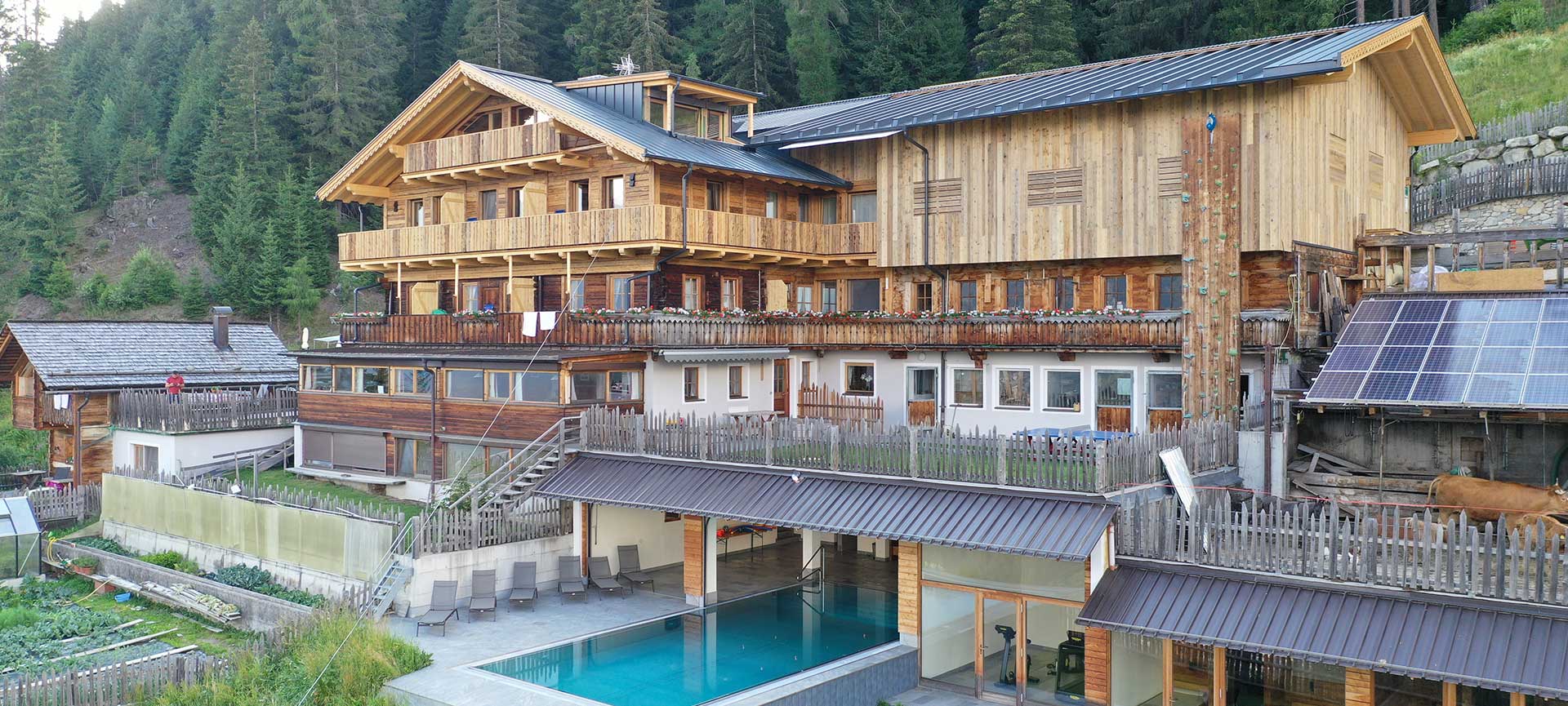
Our traditional, certified organic farm is run with great passion by us, the Jud family (Manfred, Alexia, and the children). Awarded the highest rating of 5 Flowers by the Red Rooster, the Glinzhof is located on the sunny side of the Pustertal valley on the Innichberg. Away from noise and hustle, you can enjoy a tranquility here that is rarely found today. But the farm not only scores with its unique view of Innichen and the Haunold, but also offers cyclists perfect all-round comfort after the exertions on the Pustertal Cycle Path:
1. Excellent Organic Cuisine for Hungry Cyclists
An active day requires the right culinary foundation. In the morning, we spoil you in our cozy parlor with a rich breakfast buffet, where almost everything comes from our own organic farm or from selected regional partners. Freshly baked bread, homemade fruit spreads, juices, fresh eggs, and hearty cheese give you the necessary strength.
And the best part: After your return from Lienz, you no longer have to search for a restaurant. In the evenings, we cook typical South Tyrolean cuisine for our guests – fresh, sustainable, and incredibly delicious!
2. Wellness in the Infinity Pool with Dolomite View
When you return from your tour, the absolute highlight of our resort awaits you: the exclusive wellness area. Dive into our heated infinity outdoor pool, where the water visually merges seamlessly with the impressive panorama of the Dolomites.
Additionally, our sauna area (with Finnish sauna and steam bath) and the cozy relaxation rooms ensure that tired cyclist calves are regenerated in no time. This is relaxation on a whole new level!
3. A Paradise for the Whole Family (and Pets!)
Those who complete the Drau Cycle Path with children will find a true adventure land at Glinzhof. Our many animals – from cows, goats, and sheep to donkeys, ponies, llamas, and our farm dog Schnuffi – look forward to every cuddle. In addition, we live a conscious philosophy of deceleration: Our rooms are traditionally made from solid larch and spruce wood by local carpenters and come completely without a television. You will be surprised how quickly you can switch off without a TV and enjoy nature!
4. E-Mobility & Perfect Infrastructure for Your Bike
We know how important the right equipment is for a successful tour. If you don't want to bring your own bike on vacation, we have the ideal solution right on site: We have first-class, full-suspension e-bikes available for rent in-house! In line with our sustainable philosophy, we rely on green e-mobility: The bikes are exclusively charged with self-produced electricity from our own photovoltaic system. It's a very special feeling to cycle almost silently and completely CO2-neutrally through the alpine landscape. This makes cycling on the Pustertal Cycle Path twice as much fun!
Of course, we offer guests who bring their own bike a lockable, secure sports and bicycle room as well as their own charging facilities. We are also happy to provide you with maps and detailed advice on all Drau Cycle Path stages.
Practical Checklist for Your Drau Cycle Path Tour
To ensure everything runs smoothly on the day of your tour on the Puster Valley Cycle Path, we have put together a short checklist with the most important tips for you:
- The best season: The cycle path is continuously passable from May to October. In spring, blooming meadows line the path, while in autumn, the golden larch forest provides a fantastic backdrop.
- Equipment & Clothing: Since the first stage involves a lot of downhill riding and passes through shady forest sections, the wind in the Hochpustertal can be fresh. A thin wind or rain jacket is therefore essential to pack – as is sufficient sun protection for the open passages in the Lienz Basin.
- Don't forget your ID: Since you will be crossing the state border between Italy and Austria, you should always carry a valid ID card or passport in your backpack, despite the Schengen area.
- Have your Drau Cycle Path map ready: Although the signage is complete, a map (digital or on paper) helps to perfectly time culinary stops like the Loacker Genusswelt or the Vitalpinum.
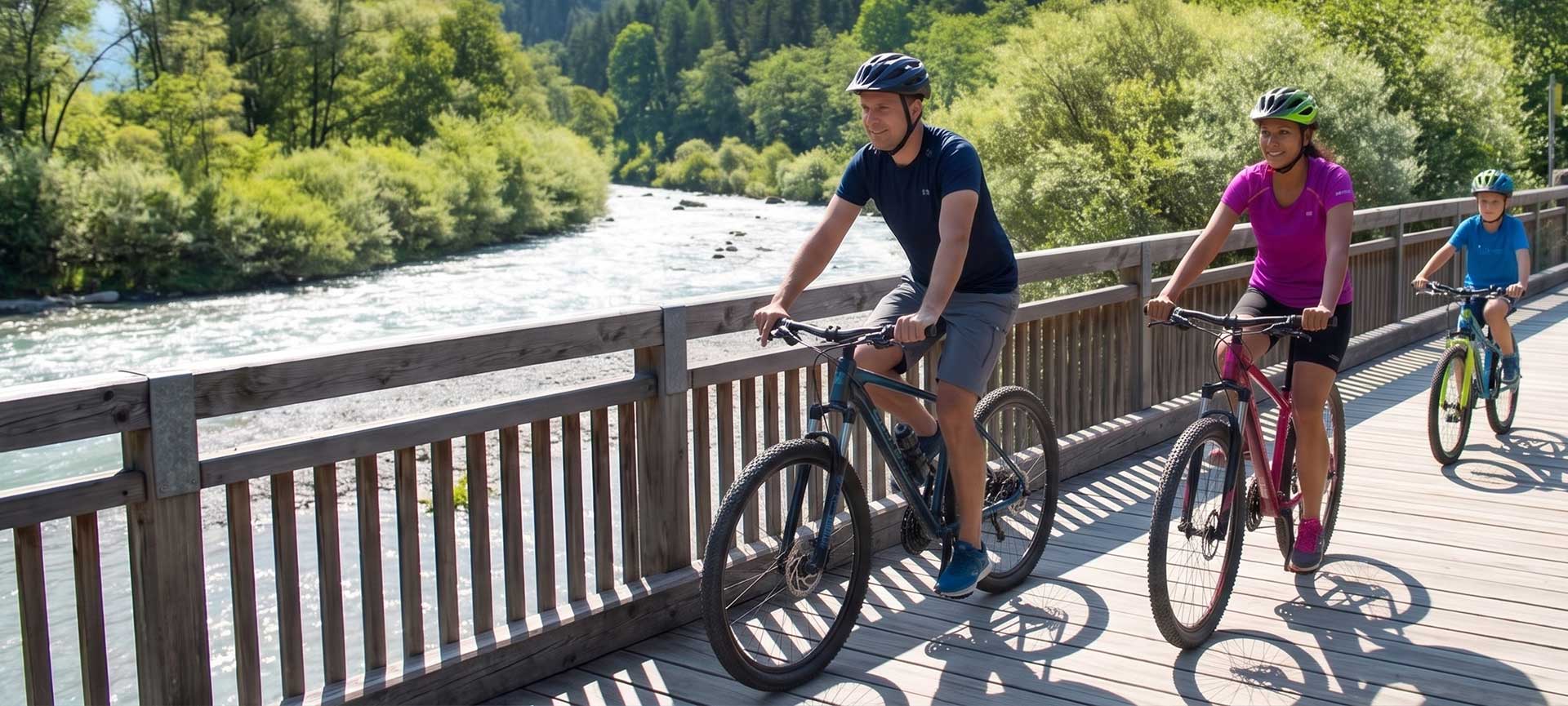
- The right bike type: The path is completely asphalted. You can easily complete the tour with a classic trekking bike, a city bike, or an e-bike.
Our tip: For maximum, CO2-neutral riding pleasure, simply rent one of our full-suspension e-bikes directly from us at Glinzhof!
The Drau Cycle Path: An unforgettable experience in the heart of the Alps
The Drau Cycle Path – and especially its first stage from Toblach/Innichen to Lienz – impressively proves that cycling holidays in the mountains don't always have to mean extreme exertion. It's a tour of contrasts:
You start in the high-alpine South Tyrol in the shadow of the world-famous Dolomite peaks and a few hours later arrive in the Mediterranean-influenced, sunny flair of the East Tyrolean district capital. In between lie crystal-clear air, culinary highlights, and the wonderful feeling of simply letting go.
When you cycle back up to the Glinzhof after an eventful day, let your gaze wander from the infinity pool over evening Innichen, and enjoy our warm hospitality, you will understand why the Hochpustertal captivates so many people.
It is the perfect symbiosis of activity on the Puster Valley Cycle Path and subsequent, deeply effective relaxation on the organic farm.
When may we provide your bicycle for the first stage of the Drau Cycle Path?
We look forward to welcoming you soon to Glinzhof and showing you the most beautiful corners of our homeland!
Frage uns einfach und schnell über unser Kontaktformular an und wir melden uns schnellstens bei dir!